



Data Liquidity, Affordability, and Access: The History & Growth of TEFCA™
February, 11 2026
The Trusted Exchange Framework and Common Agreement™ (TEFCA™) serves to bring disparate, disconnected networks of information together, in a coordinated way, to better enable care and secure patient access to their own data.
In the last year, TEFCA has experienced a significant growth in adoption, leading the path forward for seamless, secure trusted exchange of electronic health information that patients and providers can count on. Approximately 10 million documents were exchanged across TEFCA before 2025 and, by the end of 2025, 464 million documents had been exchanged.
This exponential rise displays the literal and figurative network effect of patients, providers, hospitals, and others beginning to truly exchange health data, in a trusted and secure way. We expect to begin seeing the benefits of this shift with more people having access to the records they need. We expect the use of TEFCA to continue to grow with additional exchange purposes that reflect various use cases for health information exchange. This fact sheet is designed to explain TEFCA’s history, growth, and areas of focus for the future.
A Congressional Mandate
The 21st Century Cures Act (Cures Act), enacted in 2016, called on the United States to “develop or support a trusted exchange framework, including a common agreement among health information networks nationally” (Section 4003(b) of the Cures Act). The Trusted Exchange Framework and Common Agreement, also known as TEFCA, fulfills that mandate.
TEFCA is a public-private supported network of networks led by the Assistant Secretary for Technology Policy/Office of the National Coordinator for Health IT (referred to herein as “ASTP/ONC”) that creates a standardized approach for secure, seamless, and interoperable health information exchange across the nation. TEFCA aims to bridge participating Qualified Health Information Networks® (QHINs™), as well as their members, using one set of network participation policies, one set of nationwide connectivity services, and one approach to network oversight and technology standards. Participation in TEFCA is designed to scale electronic health information exchange nationwide transparently and to help ensure that individuals, health care providers, health plans, HINs, public health, and relevant government agencies can securely access and exchange electronic health information when and where it is needed.
A Strong Foundation
ASTP/ONC administers the overall process to define the network participation and governance requirements for TEFCA. The Recognized Coordinating Entity® (RCE™), an ASTP/ONC contractor, provides oversight of QHINs, which are health information networks approved and designated to exchange data under TEFCA. QHINs connect directly to each other to facilitate nationwide electronic health information exchange. Each QHIN connects its Participants, who in turn connect Subparticipants, such as healthcare providers, health plans, or technology partners. In seconds, a patient’s information can securely move where it needs to go because all of these entities work together under the same set of agreements and in accordance with the same set of technical requirements. This shortens the process for connections, decreases paperwork for providers and patients, and supports more informed shared decision making between providers and patients.
Real Impact Across the Care Ecosystem
TEFCA makes health data sharing easier, faster, and more secure across the country—supporting better care and improved outcomes, meanwhile also decreasing costs and improving efficiency by reducing or eliminating the need to join multiple HINs, sign multiple legal agreements, and the need of point-to-point interfaces.
- Patients and caregivers: Gain easier access to their health records in one place, even when moving, changing doctors, or managing care across multiple providers.
- Providers and health systems: Spend less time managing data connections and can access more complete patient information for coordinated value-based care.
- Payers and public health agencies: Receive timely, reliable data to improve health monitoring, program management, and population health.
- Health information networks and developers: Operate under one national set of rules and standards, simplifying participation and increasing interoperability.
Making the Exchange Count
TEFCA supports the secure exchange of health information for clearly defined purposes—called Exchange Purposes. These describe why data can be shared or requested.
The six approved Exchange Purposes under the Common Agreement are summarized as follows:
- Government Benefits Determination: Permits government agencies to electronically request health data to determine eligibility for non-health benefits programs
- Health Care Operations: Supports activities like quality improvement or care coordination within a health system
- Individual Access Services: Allows patients to electronically request and securely receive their own health information
- Payment: Allows insurers to request data needed to process or approve payment for care
- Public Health: Allows health departments to request information for disease tracking or case investigations
- Treatment: Enables a provider to electronically request a patient’s records from another provider to support care
Getting Data Where it Needs to Go
TEFCA health data exchange works through secure messaging and data-sharing tools, including document exchange, HL7 ® Fast Healthcare Interoperability Resources (FHIR®) application programming interface (APIs), directory and lookup services, authentication, and use of the U.S. Core Data for Interoperability (USCDI) standards. How does it work?
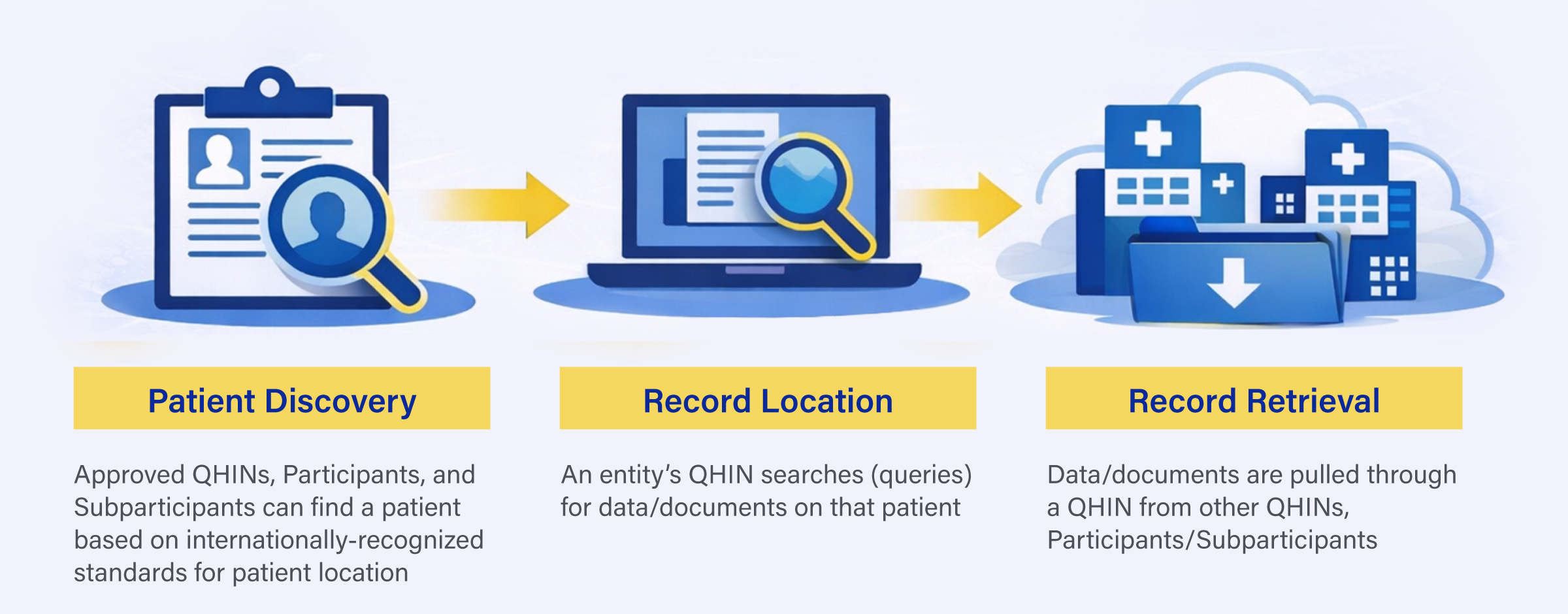
TEFCA Timeline
 January 22, 2022 – Version 1 of TEFCA Published
December 12, 2023 – TEFCA Go-Live, Initial QHIN Designations
- eHealth Exchange; Epic Nexus; Health Gorilla; KONZA National Network; MedAllies
February 12, 2024- QHIN Designations
- CommonWell Health Alliance; Kno2
December 16, 2024- HTI-2 Final Rule Published
Health Data, Technology, Interoperability: Trusted Exchange Framework and Common Agreement (HTI-2) Final Rule published – effective January 15, 2025
January 16, 2025- QHIN Designation
- eClinicalWorks
April 15, 2025- QHIN Designation
- Surescripts
August 5, 2024- QHIN Designation
- Netsmart
November 28, 2025- QHIN Designation
- Oracle Health Information Network
Across the Country
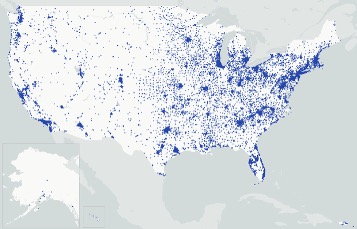
From small providers to provider groups to hospital systems, currently over 71,000 sites or organizations are participating in TEFCA through 11 QHINs. The map below illustrates the participants and subparticipants that are exchanging data on the Network:
Federal partners have joined as well to support those they work with around the country. The Indian Health Services (IHS) was the first federal agency to select a QHIN for TEFCA participation. The Social Security Administration (SSA) was involved with the development of their own sub-exchange purpose within the Government Benefits Determination Exchange Purpose.
Connecting to TEFCA
As an Individual…
Health apps and technology vendors that are connected to TEFCA can provide patients with the ability to seek access to their electronic health information through the individual access services exchange purpose. These individual access services providers are chosen by the individual and must agree to the terms that all participants in TEFCA sign on to, as well as additional requirements to provide transparency on how they collect, share, and use an individual’s health information when using their applications. How does it work? When an individual makes a request, the individual access services provider is their technical connection to the network and either communicates their request as a query through a QHIN to find all electronic health information available for them and return it back to them in a secure and standardized format or facilitates a FHIR-based approach.
As a Participant or Subparticipant…
To participate in TEFCA, entities can decide to work with a QHIN of their choice. An entity can connect to the TEFCA network through a direct connection to a QHIN (as a Participant) or through a health information network or technology provider that is already connected to a QHIN (and be a Subparticipant). Some examples of who can be a Participant or Subparticipant include but are not limited to: Federal agencies, Health Information Networks/Exchanges, Health Plans and other Payers, Individuals, Providers, and Public Health Agencies.
Thinking about joining TEFCA as a Participant or Subparticipant?
- Identify your needs
- Research QHINs or other connections to TEFCA (e.g., EHRs, health information exchanges [HIEs])
- Review the agreement that must include the Terms of Participation
- Select a QHIN or other connections to TEFCA and complete technical and compliance steps
- Get listed in the RCE Directory (the directory enables QHINs to identify other QHINs, Participants, and Subparticipants to exchange data)
- Start exchanging
As a QHIN…
QHINs serve as the backbone for nationwide data sharing under TEFCA. To become a QHIN, a network must meet strict technical and security standards and agree to a common set of participation rules (i.e., the Common Agreement). Once designated, any organization connected to one QHIN can securely exchange data with participants in any other QHIN.
The process of onboarding to TEFCA as a QHIN includes:
- Submit intent to apply to the RCE
- Application submission to the RCE
- Application review by the RCE
- Pre-Production Testing Process and Project Plan Completion
- Designation and Post-Production Testing
- Production QHIN Exchange
For more information on QHIN onboarding, please refer to the Standard Operating Procedure (SOP): QHIN Onboarding and Designation.