An official website of the United States government

Here’s how you know

Official websites use .gov
A .gov website belongs to an official government organization in the United States.

Secure .gov websites use HTTPS
A lock ( ) or https:// means you’ve safely connected to the .gov website. Share sensitive information only on official, secure websites.

ASTP Logo
Skip Navigation
  • Topics
      • Featured
        • Featured

        • Certification of Health IT

          Ensures health IT meets standards for functionality, security, and interoperability.

        • Information Blocking

          Regulations ensuring health data is shared appropriately without improper barriers.

        • Interoperability

          Enables secure and seamless exchange of electronic health information among authorized users.

        • Health Information Technology Advisory Committee (HITAC)

          Advises on policies, standards, and implementation specifications for health data and technology.

        • United States Core Data for Interoperability (USCDI)

          Offers a standardized set of health data classes and constituent data elements for nationwide, interoperable health information exchange.

        • Trusted Exchange Framework & Common Agreement (TEFCA)

          Operates as a nationwide framework for the interoperability of electronic health information.

      • Artificial Intelligence
        • Artificial Intelligence

        • Artificial Intelligence (AI) at HHS

          HHS’ list of AI use cases is publicly available to search and reference. In addition to AI use case summaries, the inventory also includes information on data, IT infrastructure, internal governance, and much more.

      • Care Continuum
        • Care Continuum

          Explore the roles of health information and technology in broad healthcare settings, supporting seamless, coordinated patient care from prevention through recovery.

        • Care Settings

        • Behavioral Health

          Health information, policies, and technology supporting integrated care for mental health and substance use disorders.

        • Emergency Medical Services

          Rapid response and communication during health emergencies through health information and technology.

        • Long-Term & Post-Acute Care

          Health information and technology facilitating coordinated care beyond acute settings.

        • Maternal & Pediatric Care

          Technology addressing unique health needs of mothers and children.

        • Pharmacy & PDMP

          Electronic tools tracking controlled substance prescriptions to improve patient safety.

        • Public Health

          Using health information and technology to prevent disease, diagnose health conditions, and promote population health.

        • Clinical Topics

        • Clinical Quality & Safety

          Optimal care through measuring results, prioritizing improvements, and implementing and monitoring results.

        • Usability & Provider Burden

          Promotes health information and technology usability to reduce clinician burden and enhance patient care.

      • Interoperability
        • Interoperability

          Promotes standardized exchange and use of electronic health data to improve patient care, coordination, and public health outcomes.

        • Health IT Interoperability

          Enables secure and seamless exchange of electronic health information among authorized users.

        • Trusted Exchange Framework & Common Agreement (TEFCA)

          Facilitates secure, nationwide electronic health information sharing to connect providers, patients, public health agencies, and payers.

        • Certification of Health IT

          Provides certification criteria for developers of health IT modules that ensures health IT products meet the standards for functionality, security, and interoperability.

        • Standards & Technology

          Advance healthcare quality and safety through standardized health IT and secure health data exchange.

        • Information Blocking

          Prevents practices that interfere with the access, exchange, or use of electronic health information, as defined by the Cures Act.

        • Interoperability Standards Platform

          Serves as a homepage for tools and resources for understanding and using health IT standards and technologies.

        • Investments

          Support interoperability improvements nationwide.

        • Health IT & Health Information Exchange Basics

          Enable secure electronic sharing and access of patient health information, supporting healthcare providers and patients across care settings.

        • Patient Access to Health Records

          Ensure patients have secure and convenient access to their health records, supported by healthcare providers and health IT developers under HIPAA.

      • Policy
          • Policy

            Outlines federal regulations and strategic initiatives guiding effective use and secure exchange of electronic health information.

            • Legislation

              Delivers improvements in the delivery and experience of health care while enhancing health outcomes by leveraging health information technology.

            • Regulations

              Supports the adoption and promotion of standards-based health information.

            • TEFCA

              Operates as a nationwide framework for the interoperability of electronic health information.

            • HHS Health IT Alignment Program

              Coordinates health data and technology initiatives across HHS to enhance interoperability and effectiveness.

            • Health Information Technology Advisory Committee (HITAC)

              Advises on policies, standards, and implementation specifications for health data and technology.

            • Privacy & Security

              Protects electronic health information security through policy.

          • Rulemaking

          • HTI Rules

            Health data interoperability regulations ensuring secure, effective technology use.

          • Information Blocking

            Policies to prevent practices interfering with the access, exchange, and use of electronic health information.

          • Certification Program Rules

            Ensures health IT meets standards for functionality, security, and interoperability.

      • Research & Analysis
        • Research & Analysis

          Interactive datasets related to health IT data analysis, providing insights into adoption and use.

        • Dashboards

          Gives data-driven insight on how dashboards are driving health IT adoption and how they have helped users to meet federal healthcare incentives or programs.

        • Data Briefs

          Provides health IT adoption and use statistics derived from surveys and administrative data and in-depth analysis of health IT policies and programs.

        • Datasets

          Grants access to raw datasets from ASTP related to health IT adoption, health IT capabilities and other topics.

        • Quick Stats

          Streamlines data into visualizations of key data and summarizes the latest statistics, facts and figures about health IT.

        • About Health IT Research & Analysis

          Provides information about how health IT data are collected, analyzed, and published.

  • Resources & Tools
      • Featured
        • Featured Resources & Tools

          Highlights key tools and guidance supporting effective health IT implementation, interoperability, patient engagement, and compliance with federal standards.

        • Interoperability Standards

          ASTP’s initiatives in health data standards enable secure electronic health data exchange.

        • TEFCA Resources

          Data sheets, videos, and documents to guide users of the TEFCA framework and exchange.

        • Implementation Resources

          Technical resources and tools supporting healthcare providers, clinicians, and developers of health IT products.

        • Health IT Playbook

          Strategies, recommendations, and best practices for implementing and using health data and technology.

        • Security Risk Assessment Tool

          Desktop application supporting providers conducting HIPAA security risk assessments.

        • Patient Engagement Playbook

          Practical reference tool for clinicians, staff, and other innovators around the world to improve patient engagement.

        • Certified Health IT Product List (CHPL)

          A comprehensive and authoritative listing of successfully tested and certified health IT modules.

        • Conformance Test Tools & Edge Testing Tool

          Resources for developers implementing standards to enable health information interoperability.

        • Health IT Feedback Form

          Users can submit feedback regarding health data and technology usability, interoperability, and compliance issues.

      • Resources
        • Resources

          Collection of practical materials, videos, educational tools, and user guides designed to support successful implementation and adoption of health IT systems.

        • Get It, Check It, Use It Guide

          A guide for patients and caregivers who want to access, review, and use their health records.

        • Video Resources

          A repository of informational videos created by ASTP.

        • Health IT Curriculum Resources for Educators

          Instructional materials to help healthcare workers stay current in the changing healthcare environment and deliver care more effectively.

        • Fact Sheets

          A repository of fact sheets created by ASTP.

      • Tools & Technology
          • Implementation

          • Certified Health IT Product List

            A comprehensive and authoritative listing of successfully tested and certified health IT modules.

          • Electronic Clinical Quality Improvement Resource Center

            Provides common standards and shared technologies to monitor and analyze the quality of health care and patient outcomes.

          • Security Risk Assessment Tool

            Desktop application supporting providers conducting HIPAA security risk assessments.

          • Tools

          • Edge Testing Tool

            A centralized collection of testing tools and resources supporting health IT developers and users fully evaluating specific technical standards.

          • Conformance Test Tools

            ONC-approved conformance resources supporting developers implementing standards to enable health information interoperability.

          • Get It, Check It, Use It Guide

            A guide for patients and caregivers who want to access, review, and use their health records.

          • Quick Links

          • Certification & Testing
          • USCDI
          • USCDI+
          • Interoperability Standards Platform (ISP)
          • FHIR
          • ASTP Standards Bulletins
          • Patient ID & Matching Adopted Standards for HHS
  • News & Events
      • Media Center
      • News
      • Events
      • Featured Blogs & News

      • TEFCAâ„¢, America’s National Interoperability Network, Reaches Nearly 500 Million Health Records Exchanged as HHS Leverages Technology and AI to Lower Costs and Reduce Burden

        TEFCA™, America’s National Interoperability Network, Reaches Nearly 500 Million Health Records Exchanged as HHS Leverages Technology and AI to Lower Costs and Reduce Burden

        Source: ASTP/ONC Today, HHS, through the Office of the Assistant Secretary for Technology Policy/Office of the National Coordinator for Health…

        HTI-5 Proposed Rule

        HTI-5 Proposed Rule

        HTI-5 Proposed Rule The Assistant Secretary for Technology Policy/Office of the National Coordinator for Health Information Technology (ASTP/ONC) published the…

        TEFCA’s growing, are you in? Take a look at who’s participating in TEFCA Exchange

        TEFCA’s growing, are you in? Take a look at who’s participating in TEFCA Exchange

        We are pleased to announce that the beta version of an interactive, searchable map for TEFCAâ„¢ participation is now available. The map released today is another example of our commitment to transparency.

  • About
      • Overview
        • About ASTP

          Mission, role, and responsibilities of ASTP.

        • Leadership

          Profiles of ASTP’s senior leadership team.

        • History

          Timeline of ASTP’s evolution and key milestones.

        • Budget & Performance

          Financial reports and performance accountability.

        • Investments

          Strategic investments in programs, policies, and technology.

        • Reports to Congress

          Annual health data and technology progress updates to Congress.

      • Careers
        • Careers at ASTP

          View opportunities with ASTP.

        • Working at ASTP

          Overview of workplace culture and employee experience.

      • Contact
        • Contact Us

          Reach ASTP with general inquiries.

        • Health IT Feedback Form

          Users can submit feedback regarding health data and technology usability, interoperability, and compliance issues.

        • Report Issue with Certified Health IT

          Complaint process to resolve any issues of potential noncompliance with certification requirements.

        • Information Blocking Claim

          Form to report alleged information blocking practices.

        • Speaker Request

          Form to request ASTP experts for speaking engagements.

      • Funding Opportunities
        • Funding Announcements

          ASTP’s contractors and grantees play a valuable role in helping promote better health care for Americans by fostering interoperable health data and technology.

        • Grants Management & Process

          Learn about opportunities for funding through grants and cooperative agreements.

  • Blog
Popular searches: certifications information blocking interoperability

Health IT Research & Analysis

    • Data Types
    • Categories
    • Sort By
Data Briefs iconData Briefs

Electronic Capabilities for Patient Engagement among U.S. Non-Federal Acute Care Hospitals: 2013-2017

No. 45 | April 2019
  • Electronic Capabilities for Patient Engagement among U.S. Non-Federal Acute Care Hospitals: 2013-2017 [PDF – 432.83 KB]
Link to Page Icon Link to Page
  • Overview

The Medicare and Medicaid Electronic Health Record (EHR) Incentive Programs incentivized hospitals to provide patients access to their health information through the use of certified EHR technology. Since 2014, eligible hospitals were required to provide patients with the capability to view, download, and transmit (VDT) their health information (1). VDT capability provides patients with electronic access to their personal health information. Other electronic patient engagement capabilities allow hospitals and their patients to interact online. This data brief explores the trends and variation in hospitals’ adoption of VDT and other electronic patient engagement capabilities.

Highlights

  • In 2017, nearly all hospitals provided patients with the ability to electronically view and download their health information.
  • Significantly fewer critical access hospitals (CAHs) provided patients with the ability to VDT compared to non- CAHs.
  • Most hospitals (62 percent) reported that fewer than 25 percent of their patients activated their access to their patient portal.
  • Nearly 4 in 10 hospitals reported that patients could access their health information using an application that connects to the hospital’s EHR through an application programming interface (API).
  • The percent of hospitals who provided patients access to their health information using an API did not vary by hospital type.

Nearly all hospitals provided patients with the ability to electronically view and download their health information in 2017.

Figure 1: Percent of non-federal acute care hospitals where patients are able to electronically view, download, and transmit their health information, 2013, 2015, and 2017.
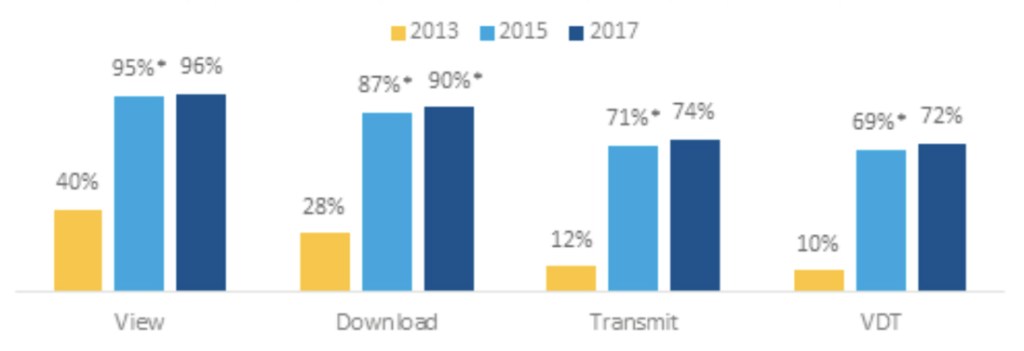
It shows percentages for four categories: view, download, transmit and VDT across three years: 2013, 2015 and 2017. View is 40, 95 and 96 percent for 2013, 2015 and 2017. 95 percent is statistically significantly different from 40 percent. Download is 28, 87 and 90 percent for 2013, 2015 and 2017. 87 percent is statistically significantly different from 28 percent, and 90 percent is statistically significantly different from 87 percent. Transmit is 12, 71 and 74 percent for 2013, 2015 and 2017. 71 percent is statistically significantly different from 12 percent. VDT is 10, 69 and 72 percent for 2013, 2015 and 2017. 69 percent is statistically significantly different from 10 percent.
SOURCE: 2013, 2015, and 2017 American Hospital Association (AHA) Annual Survey Information Technology Supplement.
NOTES: *Significantly different from previous two years (p<0.05). These data reflect hospital responses to questions regarding whether the hospital provides its patients with the ability to view, download and transmit their health information (see Definitions). These results may not be comparable to other industry measures of view, download and transmit.
  • The percent of hospitals that provided patients with the ability to VDT increased seven-fold from 2013 to 2015. However, VDT rates did not significantly change from 2015 to 2017.
  • In 2017, about 3 in 4 hospitals provided patients with the ability to transmit their health information.

CAHs were less likely than non-CAHs to provide patients with the ability to VDT their health information.

Figure 2: Percent of non-federal acute care hospitals where patients are able to electronically VDT their health information by hospital type, 2017.
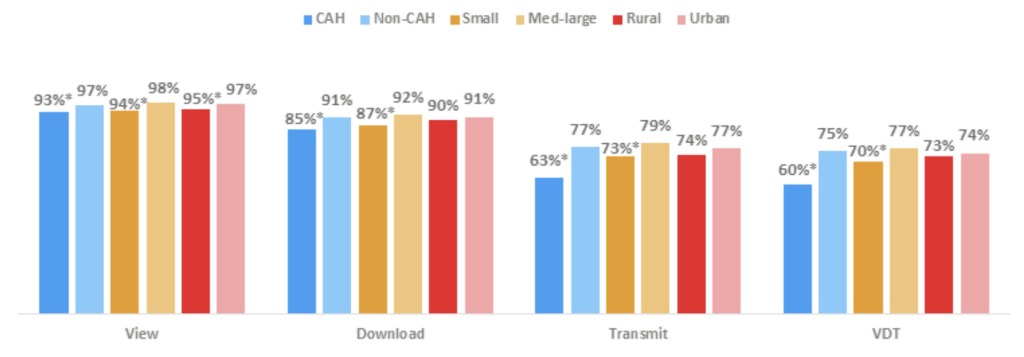
It shows percentages for four categories: view, download, transmit and VDT across six categories of hospital types: critical access hospital, non-critical access hospital, small hospital, medium and large hospital, rural hospital and urban hospital. All percentages are as of 2017. View is 93, 97, 94, 98, 95 and 97 percent across these hospital types. Critical access hospitals are statistically significantly less than non-critical access hospital. Small hospitals are statistically significantly less than medium and large hospitals. Rural hospitals are statistically significantly less than urban hospitals. Download is 85, 91, 87, 92, 90 and 91 percent across these hospital types. Critical access hospitals are statistically significantly less than non-critical access hospital. Small hospitals are statistically significantly less than medium and large hospitals. Transmit is 63, 77, 73, 79, 74 and 77 across these hospital types. Critical access hospitals are statistically significantly less than non-critical access hospital. Small hospitals are statistically significantly less than medium and large hospitals. VDT is 60, 75, 70, 77, 73 and 74 across these hospital types. Critical access hospitals are statistically significantly less than non-critical access hospital. Small hospitals are statistically significantly less than medium and large hospitals.
SOURCE: 2017 AHA Annual Survey Information Technology Supplement.
Notes: *Significantly different from its counterpart p<0.05). Critical Access hospitals are hospitals with less than 25 beds and at least 35 miles away from another general or critical access hospital. Small hospitals are all non-Critical Access hospitals with less than 100 beds. Med-large hospitals have >100 beds. Rural hospitals are all non-Critical Access hospitals in non-urban metropolitan areas.
  • Although nearly all hospitals provided patients with the ability to view their health information, small, rural and CAHs lagged behind their counterparts by at least 2 percentage points.
  • Hospitals where patients are able to download their health information did not vary significantly between rural (90 percent) and urban (91 percent) hospitals.
  • About 5 percent fewer CAHs and small hospitals provided patients with the ability to download their health information compared to non-CAHs and medium and large hospitals, respectively.
  • Compared to medium-large hospitals, fewer small hospitals provided patients with the ability to VDT (77 percent and 70 percent, respectively).
  • CAHs and non-CAHs had the greatest difference, 15 percentage points, between hospital types that provided patients with the ability to VDT.

Nearly two-thirds of hospitals had fewer than 25 percent of patients activate access to the hospital’s patient portal in 2017.

Figure 3: Percentage of patients who activated access to their patient portal by hospital type, 2017.
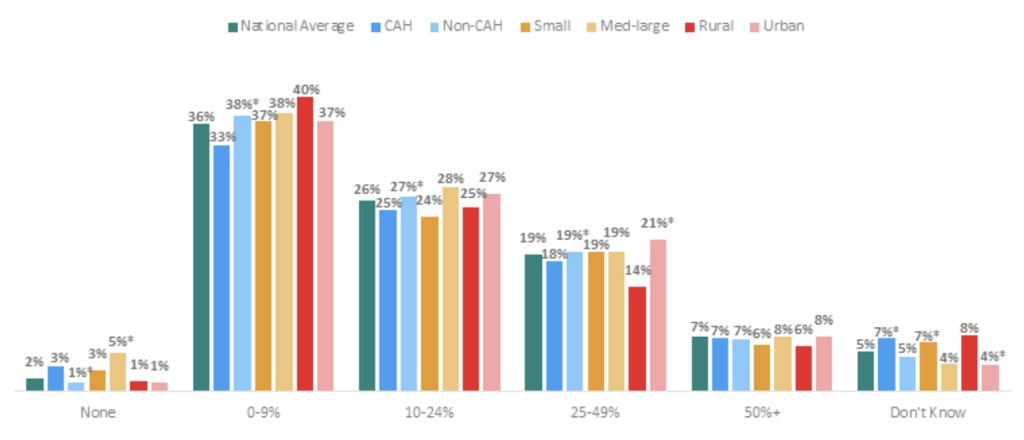
It shows percentages for six categories: None patients activated access, 0-9 percent activated access, 10-24 percent, 25-49 percent, 50 and greater and hospitals don’t know percent of patients who activated access. These percentages are shown across six hospital types: all hospitals, critical access hospital, non-critical access hospital, small hospital, medium and large hospital, rural hospital and urban hospital. All percentages are as of 2017. None is 2, 3, 1, 3, 5, 1 and 1 percent across all hospital types. Non-critical access and medium large are statistically significantly different. 0-9 percent is 36, 33, 38, 37, 38, 40 and 37 across all hospital types. Non-critical hospitals are statistically significantly different. 10-24 percent is 26, 25, 27, 24, 28, 25 and 27 percent across all hospital types. Non-critical hospitals are statistically significantly different. 25-49 percent is 19, 18, 19, 19, 19, 14 and 21 percent across all hospital types. Non-critical hospitals and urban hospitals are statistically significantly different. 50 and greater is 7, 7, 7, 6, 8, 6 and 8 percent across all hospital types. Don’t know is 5, 7, 5, 7, 4, 8 and 4 percent across all hospital types. Critical access hospitals, medium and large hospitals and urban hospitals are statistically significantly different.
SOURCE: 2017 AHA Annual Survey Information Technology Supplement.
Notes: *Significantly different from its counterpart p<0.05). Critical Access hospitals are hospitals with less than 25 beds and at least 35 miles away from another general or critical access hospital. Small hospitals are all non-Critical Access hospitals with less than 100 beds. Med-large hospitals have >100 beds. Rural hospitals are all non-Critical Access hospitals in non-urban metropolitan areas. Approximately 4 percent of respondents are missing.
  • Overall, few hospitals (8 percent or less) reported that 50 percent or more of patients activated access to their patient portal.
  • On average, four in 10 hospitals reported that 0 to 9 percent of patients activated their patient portal.
  • The proportion of rural hospitals (14 percent) that reported 25 to 49 percent of patients activated access to their patient portal, is significantly lower than the proportion of urban hospitals (21 percent); this indicated the greatest variation among hospital types.
  • Compared to CAHs (33 percent), non-CAHs (38 percent) were more likely to report 0-9 percent of patients activated access to their patient portal.
  • There were no significant differences between small and medium-large hospitals for the percent of patients who activated access to their patient portal, except for those who reported no patients activated their access to their patient portal.

In 2017, four in 10 hospitals reported offering their patients access to their health information using an application programming interface (API).

Figure 4: Electronic capabilities offered by non-federal acute care hospitals to their patients (excluding view, download, and transmit), by year, 2013, 2015, and 2017.
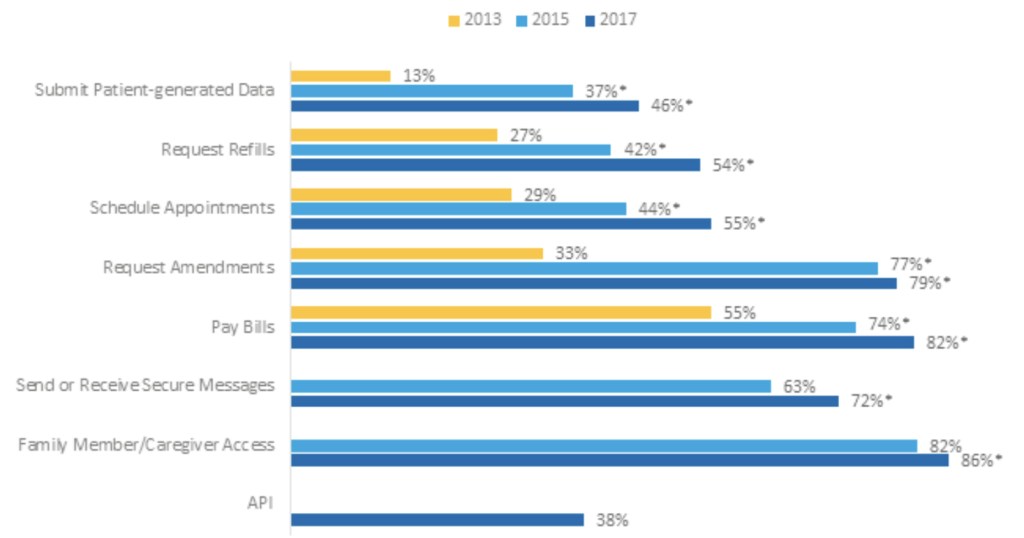
It shows percentages for eight categories: submit patient-generated data, request refills, schedule appointments, request appointments, pay bills, send or receive secure messages, family member and caregiver access and API. Data are presented for three years: 2013, 2015 and 2017. Submit patient-generated data is 13, 37 and 46 percent. 37 is statistically significantly different from 13, and 46 is statistically significantly different from 37. Request refills is 27, 42 and 54. 42 is statistically significantly different from 27, and 54 is statistically significantly different from 42. Schedule appointments is 29, 44 and 55. 44 is statistically significantly different from 29, and 55 is statistically significantly different from 44. Request amendments is 33, 77 and 79. 77 is statistically significantly different from 33, and 79 is statistically significantly different from 77. Pay bills is 55, 74 and 82. 74 is statistically significantly different from 55, and 82 is statistically significantly different from 74. Send or receive secure messages is for 2015 and 2017 only 63 and 72 percent. 72 is statistically significantly different from 63. Family member and caregiver access is for 2015 and 2017 only 82 and 86 percent. 86 is statistically significantly different from 82. API is for 2017 only 38 percent.
SOURCE: 2013, 2015, and 2017 AHA Annual Survey Information Technology Supplement.
Notes: *Significantly different from previous 2 years (p<0.05). Family/Caregiver access and send or receive secure messages questions were added to the 2015 AHA Annual Survey Information Technology Supplement. API questions are new to the 2017 AHA Annual Survey Information Technology Supplement.
  • In 2017, the capabilities most frequently available to patients were: family members or caregiver access on behalf of the patient (86 percent), pay bills online (82 percent), and request amendments to their health record (79 percent).
  • Between 2013 and 2017 the percentage of hospitals that provided patients with the ability to request prescription refills and request amendments to their health records increased by 27 and 46 percent respectively.
  • Between 2015 and 2017, the percent of hospitals that provided patients with the ability to request prescription refills electronically, increased by 12 percentage points to 54 percent.
  • The percent of hospitals that provided patients with the ability to request amendments to their health record reported the smallest increase from 2015 to 2017 (2 percentage points).
  • Hospitals that provided patients with the ability to submit patient generated data increased four-fold from 2013 to 2017.

In 2017, fewer CAHs, small, and rural hospitals offered patients electronic capabilities (excluding VDT) compared to their counterparts.

Table 1: The percent of non-federal acute care hospitals that offered electronic capabilities to their patients (excluding view, download, and transmit), by hospital type, 2017.

 APICaregiver accessRequest AmendmentsRequest RefillsSchedule AppointmentsPay BillsSubmit patient-generated DataSend or Receive Secure Messages
Rural38%81%72%48%42%75%36%66%
Urban37%90%*85%*58%*65%*86%*53%*76%*
Small39%82%73%49%44%76%39%68%
Med-Large36%90%*85%*58%*65%*87%*52%*76%*
CAH39%79%69%49%40%71%37%68%
Non-CAH37%89%*84%*55%*61%*86%*49%*73%*
SOURCE: 2017 AHA Annual Survey Information Technology Supplement.
NOTES: *All values across row significantly different from category listed directly above (p<0.05). For example, all values across CAHs significantly different from non- CAHs. Critical Access hospitals are hospitals with less than 25 beds and at least 35 miles away from another general or critical access hospital. Small hospitals are all non-Critical Access hospitals with less than 100 beds. Medium hospitals have between 100 and 399 beds. Large hospitals have 400 or more beds. Rural hospitals are all non-Critical Access hospitals in non-urban metropolitan areas.
  • The percent of hospitals that provided patients access to their health information using an API did not vary by hospital type.
  • Rural hospitals (36 percent) were less likely than urban hospitals to provide the capability for patients to submit patient-generated data.
  • Nearly 90 percent of urban, medium-large, and non-CAHs offered family members or caregivers electronic access to a patient’s information; compared to 80 percent of rural, small, and CAHs.
  • The capability to schedule appointments had the greatest variation among hospital types with difference of at least 21 percentage points between small, rural, and CAHS and their counterparts.
  • Nine in 10 urban and medium-large hospitals, offered patients the capability to request amendments to their health record compared to 7 in 10 rural and small hospitals; which is lower than the national average (8 in 10).

Summary

To participate in the Medicare and Medicaid Electronic Health Record (EHR) Incentive Programs, now renamed the Promoting Interoperability Program (PI), hospitals are required to use certified EHR technology. One aspect of program participation called for hospitals to provide patients with the ability to VDT their health information. In 2017, nearly all hospitals provided patients with the ability to electronically view and download their health information. In 2017, nearly 3 in 4 hospitals allowed patients to VDT their health information. From 2013 to 2017, the proportion of hospitals where patients are able to VDT increased seven-fold. Moreover, since 2015, the percent of hospitals that allowed patients to download their health information increased to 90 percent. However, other required functions (view and transmit) remained constant.

Hospitals’ possession of patient engagement capabilities varied by hospital type. A significantly lower percentage of CAHs provided patients with VDT capabilities. In 2017, 60 percent of CAHs compared to 75 percent of non-CAHs provided patients with VDT capabilities. Similarly, 70 percent of small hospitals provided patients with the ability to VDT compared to 77 percent of larger hospitals. There were no significant differences between rural and urban hospitals.

In 2017, the EHR Incentive Programs, required hospitals to provide 50 percent or more of its unique discharged patients with timely access to VDT their health information. Hospitals were also required to report whether patients acted to use this access (2). In 2017, almost two-thirds of hospitals reported that fewer than 25 percent of patients activated their access to the hospital’s patient portal. About 2 in 5 hospitals reported between 0 and 9 percent of patients accessed their health information through their patient portal. For 2019, the PI Program requires hospitals to report whether at least one unique discharged patient is provided timely access to VDT their health information to a third party or using an app (3).

Hospitals’ rates of patients accessing their patient portal also varied by hospital type. For example, compared to CAHs (33 percent), non-CAHs (38 percent) were more likely to report 0-9% of patients activated access to their patient portal. There was no significant difference between small and medium-large hospitals for the percent of patients who activated access to their patient portal. However, larger hospitals were more likely to report that no patients activated their access to their patient portal.

In addition to VDT, hospitals offered eight other electronic capabilities to their patients. In 2017, most hospitals (86 percent) allowed a family member or caregiver to access information on a patient’s behalf. Eight in 10 hospitals allowed patients to pay bills and request amendments to their health record. Additionally, the percent of hospitals that allowed patients to submit patient-generated data increased by four-fold between 2013 and 2017. However, CAHs, small, and rural hospitals offered patients fewer electronic capabilities compared to their counterparts. For example, rural and small hospitals were less likely to allow patients the capability to request amendments to their health record compared to their counterparts and the national average.

APIs can enhance patients’ access to their health information and improve how they engage with health care providers. Starting in 2019, hospitals participating in the PI Program must provide patients with the ability to use a third-party app of their choice to access their patient health information electronically. Prior ONC analysis revealed that 82% of hospitals have a vendor with products that meet the 2015 Edition API criteria available. We found that in 2017 38% of hospitals reported that patients can access their health information using an API (4).

Programs that encourage hospitals to provide these capabilities to patients are important to ensure that patients have their health information when and where they need it. A government-wide initiative, MyHealthEData, was launched by the White House Office of American Innovation that includes participation from the Centers for Medicare and Medicaid Services (CMS), the National Institutes of Health (NIH), Veteran Affairs (VA), and ONC (5, 6). The goal of MyHealthEData is to break down the barriers patients experience with accessing their electronic health information and give them the power to determine where and how their health information is shared. ONC supports this initiative by continuing its work on advancing the availability of APIs through rulemaking to drive patient and clinician access to data (6). In addition, ONC has collaborated with the HHS Office for Civil Rights (OCR) on the ONC Guide to Getting Your Health Records to educate patients on their Health Insurance Portability and Accountability Act (HIPAA)-protected access right and how to get access to their online health records (7). Programs, like PI and MyHealthEData and collaborations with other federal offices, will encourage patients to access and use their data; hence helping the nation to achieve an interoperable system that empowers patients.

Definitions

Non-federal acute care hospital: Includes acute care general medical and surgical, children’s general, and cancer hospitals owned by private/not-for-profit, investor-owned/for-profit, or state/local government and located within the 50 states and District of Columbia.

View: Are patients treated in a hospital able to view their health/medical information online. Download: Are patients treated in a hospital able to download information from their health/medical record.

Transmit: Are patients treated in a hospital able to electronically transmit (send) transmission of care/referral summaries to a third party.

Interoperability: The ability of a system to exchange electronic health information with and use electronic health information from other systems without special effort on the part of the user (2). This brief further specifies interoperability as the ability for health systems to electronically send, receive, find, and use health information with other electronic systems outside their organization.

Small hospital: Non-federal acute care hospitals of bed sizes of 100 or less.

Medium-large hospital: Non-federal acute care hospitals of bed sizes of 100 or more.

Rural hospital: Located in a non-metropolitan statistical area.

Critical Access Hospital: Less than 25 beds and at least 35 miles away from another general or critical access hospital.

Application program Interface (API): APIs are technology that allow one software program to access the services provided by another software program. Note: Software programs could include web-based applications or mobile apps.

Data Source and Methods

Data are from the American Hospital Association (AHA) Information Technology (IT) Supplement to the AHA Annual Survey. Since 2008, ONC has partnered with the AHA to measure the adoption and use of health IT in U.S. hospitals. ONC funded the 2018 AHA IT Supplement to track hospital adoption and use of EHRs and the exchange of clinical data.

The chief executive officer of each U.S. hospital was invited to participate in the survey regardless of AHA membership status. The person most knowledgeable about the hospital’s health IT (typically the chief information officer) was requested to provide the information via a mail survey or secure online site. Non-respondents received follow-up mailings and phone calls to encourage response.

The survey was fielded from January 2018 to the end of May 2018. The response rate for non-federal acute care hospitals was 64%. A logistic regression model was used to predict the propensity of survey response as a function of hospital characteristics, including size, ownership, teaching status, system membership, and availability of a cardiac intensive care unit, urban status, and region. Hospital-level weights were derived by the inverse of the predicted propensity.

References

1. Centers for Medicare & Medicaid Services. Medicare and Medicaid EHR Incentive Programs. Available from: https://www.cms.gov/medicare/regulations-guidance/promoting-interoperability-programs

2. EHR Incentive Programs in 2015 through 2017 Patient Electronic Access. Available from: https://www.cms.gov/Regulations-and-Guidance/Legislation/EHRIncentivePrograms/Downloads/2016_PatientElectronicAccess.pdf

3. Medicare Promoting Interoperability Program Eligible Hospitals, Critical Access Hospitals, and Dual-eligible Hospitals Attesting to CMS Objectives and Measures for 2019. Available from: https://www.cms.gov/Regulations-and Guidance/Legislation/EHRIncentivePrograms/Downloads/MedicareEH_2019_Obj3.pdf

4. Posnack, Steve and Barker, Wes. (October 2018). Heat Wave: The U.S. is Poised to Catch FHIR in 2019. https://www.healthit.gov/buzz-blog/interoperability/heat-wave-the-u-s-is-poised-to-catch-fhir-in-2019. Office of the National Coordinator for Health Information Technology: Washington DC.

5. MyHealthEData Initiative Press Release. Available from: https://www.cms.gov/newsroom/press-releases/trump-administration-announces-myhealthedata-initiative-put-patients-center-us-healthcare-system

6. Rucker, D., Health Affairs. June 2018. Achieving the Interoperability Promise Of 21st Century Cures. Available from: https://www.healthit.gov/buzz-blog/interoperability/achieving-the-interoperability-promise-of-21st-century-cures

7. Office of the National Coordinator for Health Information Technology. The Guide to Getting & Using Your Health Records. Available from: https://www.healthit.gov/how-to-get-your-health-record/

Acknowledgements

The authors are with the Office of the National Coordinator for Health Information Technology, Office of Technology, Data Analysis Branch. The data brief was completed under the direction of Steve Posnack, Director of the Office of Technology and Talisha Searcy, Branch Chief Data Analysis Branch. Other staff that contributed to this document include: Lana Moriarty.

Suggested Citation

Henry J., Barker, W., & Kachay, L. (April 2019) Electronic Capabilities for Patient Engagement among U.S. Non-Federal Acute Care Hospitals: 2013-2017. ONC Data Brief, no. 45. Office of the National Coordinator for Health Information Technology: Washington DC.

Submit Feedback

Submit HealthIT.gov Feedback

Step 1 of 3

33%
Name(Required)
Please provide your email address for follow-up.
What kind of issue are you experiencing?(Required)
Select the type of issue you encountered. Select all that apply.
Where did you experience this issue?(Required)
Select the type of issue you encountered. Select all that apply.
Example: Google Chrome on PC or Safari on iPhone.

Page Information

What page did you find this issue? e.g. Interoperability, ASTP Blog
e.g. https://beta.healthit.gov/interoperability
Please provide a detailed description of the issue you experienced.
Drop files here or
Max. file size: 3 MB, Max. files: 3.
    If you have any screenshots or files related to the issue, please upload them here.

    Subscribe for Email Updates

    This field is for validation purposes and should be left unchanged.

    EXPLORE

    • Certification of Health IT
    • Information Blocking
    • Interoperability
    • Health Information Technology Advisory Committee (HITAC)
    • Patient Access to Health Records
    • TEFCA
    • Policy
    • Resources

    DATA

    • HealthData.gov
    • Health IT Research & Analysis

    NEWS & EVENTS

    • Media Center
    • ASTP Blog
    • News
    • Events

    ABOUT

    • About ASTP/ONC
    • Careers
    • Contact
    • Funding Opportunities
    ASTP Logo HHS
    Linkedin
    X
    YouTube
    • Privacy Policy
    • Website Disclaimers
    • Viewers & Players
    • GobiernoUSA.gov
    • HHS Vulnerability Disclosure Policy
    • Archived Content

    External Link Notice

    Welcome to HealthIT.gov!

    Thank you for visiting the HealthIT.gov website! We welcome your feedback using the "Submit Feedback" button at the bottom of the page to help us improve your experience!